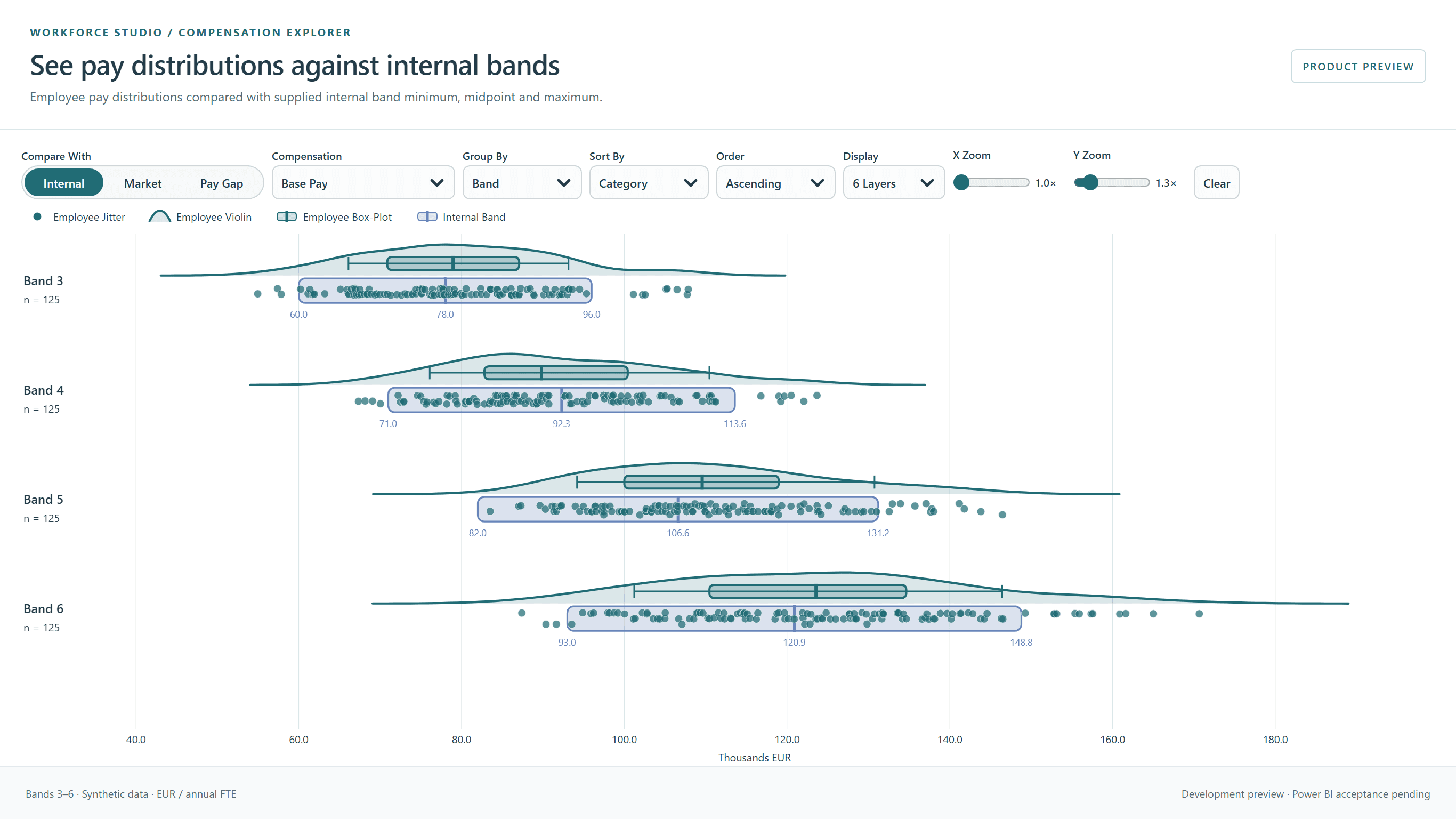
Start with the question, not the number.
A recruitment offer, a payroll check, a market comparison and an equal-pay review each need a different figure. If they silently share one, every conclusion inherits the confusion. Three questions sit behind most salary discussions, and each has its own total.
What is promised is the contractual rate at a reference date: base salary, fixed allowances and the bonus opportunity at target. It is the figure for salary positioning, offers and pay bands. What was paid is the cash that reached payroll in a period and the awards that vested. It can include last year's bonus if it was paid this year, and it is the figure for historical outcomes, including pay-gap outcomes. What it costs the employer adds social contributions, payroll taxes, recruitment and training. It belongs in workforce cost and budgets, not in anyone's personal pay.
Source: Workforce Studio, constructed example
The practical answer is a short measurement contract for every figure you use: the eligible population, the included components, gross or net, cash or non-cash, the observation period, the working-time normalisation, the currency, the valuation method and the treatment of missing values. Give it an owner and a version. A column name alone cannot carry all of that meaning.
Keep the components apart.
A total you can explain is built from pieces that do not overlap. The classification below is the data policy we recommend. Where a contract or a survey draws the line elsewhere, record the exception instead of relabelling it away.
| Component | German term | What it means here | Where it stops |
|---|---|---|---|
| Base salary | Grundgehalt | Contractual ordinary cash salary at the reference date, annualised. | Guaranteed instalments belong here if your policy includes them. Do not add a 13th salary twice. |
| Fixed cash allowances | Feste Barzulagen | Recurring, predetermined cash supplements that are separately identifiable. | A car cash allowance is not a company car. Expense reimbursements are not pay. |
| Short-term incentive (STI) | Kurzfristige variable Vergütung | A bonus tied to a year or a shorter performance period. | Store the target opportunity separately from the actual payout. Name discretionary and guaranteed awards. |
| Commission | Provision | A sales or transaction-related incentive. | Keep it separate from STI. Never count it again inside a variable-pay subtotal. |
| Overtime and shift pay | Mehrarbeits- und Schichtvergütung | Actual cash for additional hours or conditions. | A permanent fixed shift allowance may belong with fixed allowances. A fluctuating payment does not. |
| Long-term incentive (LTI) | Langfristige variable Vergütung | Cash or equity awards spanning a longer performance or vesting horizon. | The instrument, the conditions and the valuation date all matter. |
| Benefits in kind | Sachleistungen | Employer-valued personal benefits, excluding pension in this model. | Employer cost, taxable value and perceived value are three different numbers. |
| Employer pension contribution | Arbeitgeberfinanzierte Altersversorgung | Employer-funded pension value under a documented annual convention. | A defined-benefit service cost is not a contribution. Do not swap one for the other without a policy. |
Outside the ladder sit employer social contributions and payroll taxes, expense reimbursements and employment facilities, severance and termination payments. They belong in workforce-cost analysis or payroll reconciliation, not in personal pay. "Total rewards" also covers career opportunities, wellbeing and recognition. They belong in the employee proposition. Do not invent a euro value for them and add it to salary.
Build totals as a ladder.
Five levels, each adding a defined set of components to the one below, so that every total can be traced back to its pieces. This is our project convention. Surveys and countries draw the lines differently, so always read their definitions before comparing.
- the level below
- what this level adds
Source: Workforce Studio, constructed example
| Level | Built from | Mainly used for |
|---|---|---|
| 1 · Base salary | Ordinary contractual base, annual full-time equivalent at the snapshot | Salary positioning |
| 2 · Total fixed cash | Base plus qualifying fixed cash allowances | Guaranteed recurring cash |
| 3 · Total cash | Fixed cash plus STI, commission, overtime and other included cash | Cash outcome (actual) or cash opportunity (target) |
| 4 · Total direct | Total cash plus LTI, vested in the year (actual) or the annual target award (target) | Cash and equity |
| 5 · Total remuneration | Total direct plus benefits and employer pension | The broader package |
Levels 3 to 5 exist twice: an actual version built from what was paid or vested in a common twelve-month period, and a target version built from the opportunity at target performance. Never mix the two in one comparison.
Actual, target and the other bases.
The same component answers different questions depending on its basis. Store the basis with the number, and never compare a target figure with an actual one as if they were the same thing.
- Snapshot. The contractual rate today. Record the effective date, working hours and salary instalments.
- Target. What the plan would award at target performance. Record the plan year, the eligible pay definition, the target percentage and eligibility.
- Earned or accrued. What belongs economically to this performance period. Record the accrual method and later adjustments.
- Paid. What cash reached payroll in this period. Record the payment dates. A prior-year bonus may be included.
- Granted, vested, realised. Three views of one award: what was made, what became non-forfeitable, what was actually realised. Record the dates, the units and the valuation convention for each.
Equity is one award seen three times. An award worth 6,000 at grant may vest at 5,000 and be sold for 5,400. The three figures describe the same award at different moments, and adding them produces a number that means nothing. Our demo uses the annual target award value for target LTI and the vesting-date value for actual LTI. That is a compensation convention, not an accounting treatment.
Percentages need a denominator. 15% of base is not 15% of fixed cash. "On-target earnings" usually means base plus the target sales incentive and rarely includes LTI, pension or every allowance. Ask the provider what is in it.
Normalise only what you can defend.
Compensation Explorer expects annual, full-time-equivalent EUR. That conversion is simple for an ordinary salary at one date and risky for everything else.
Annual FTE base salarymonthly base × annual instalments ÷ FTE fraction
Part-time at 75%, 3,000 a month, 12 instalments: 3,000 × 12 ÷ 0.75 = 48,000. With a guaranteed 13th instalment the figure is 52,000. Not every employee has 13 instalments.
A year with changesΣ (segment rate × fraction of the year)
Build the ordinary-pay rate for each effective-dated segment and weight it by its share of the year. Do not divide a whole year’s payments by the FTE fraction at year end.
Hourly paygross earnings ÷ paid hours
Eurostat uses reference-month earnings divided by paid hours with prescribed boundaries. An annual FTE chart is not a statutory hourly-pay calculation.
Source: Workforce Studio, constructed example
Reconcile each person before you compute a statistic.
Build the total for every employee first. Only then compute medians and percentiles across people. The order matters more than it looks, as the worked example and the exhibit below show.
| Component | Actual | Target |
|---|---|---|
| Base | 60,000 | 60,000 |
| Fixed cash allowance | 3,000 | 3,000 |
| STI | 7,000 | 9,000 |
| Commission | 2,000 | 3,000 |
| Overtime | 1,000 | not part of the opportunity |
| Other included cash | 500 | not part of the opportunity |
| LTI | 5,000 vested | 6,000 annual target award |
| Benefits excluding pension | 2,000 | 2,000 |
| Employer pension | 3,000 | 3,000 |
| Total fixed cash | 63,000 | 63,000 |
| Total cash | 73,500 | 75,000 |
| Total direct | 78,500 | 81,000 |
| Total remuneration | 83,500 | 86,000 |
The 9,000 actual variable subtotal is already represented by STI and commission. Adding it again would overstate actual cash by exactly that amount. The validation order we recommend is identity, then dates, currency and working time, then atomic amounts, then totals, then the employee population, then statistics. Round source components to accounting precision before reconciling, and set a tolerance. Never overwrite an authoritative total to make a check pass.
- base
- bonus
Source: Workforce Studio, constructed example in thousands of EUR
Medians do not add up. The median base is 50 and the median bonus is 0, so median base plus median bonus gives 50. The median of the three real totals is 100. The paired data decide, which is why the visual needs each employee's prepared total, never a sum of separately computed statistics.
Jobs, positions and people.
Keep the employee as the row and everything else as attributes. The words below are often used interchangeably in organisations, which is exactly why a data model needs them kept apart. A job is a type of work. A position is an organisational seat that a job describes. A person occupies the seat. A job family groups related jobs, a grade is a job-value category from evaluation, a band is a pay-structure grouping with a range, and a step is a progression point within a band.
Use keys, not labels. Keys stay stable while labels change. Two keys with the same label remain two groups. Scope keys that are reused with different meanings, such as a grade code that differs between countries.
One row per employee. An employee with several assignments needs a policy: the principal assignment or a documented consolidated record. Duplicating people by cost centre changes medians and headcounts, and the visual rejects duplicate keys.
Evaluate the work, not the incumbent. Job evaluation should look at the work rather than the holder's current salary or negotiating power. A structured, gender-neutral method supports equal-value comparisons across differently named jobs. Market rates alone cannot.
What incentive research can and cannot tell you.
Two well-known studies are often quoted to justify bonus plans. Both are useful, and neither is a formula. Lazear's study of Safelite (2000) reports higher output after a switch to performance pay and separates the incentive effect from a workforce-selection effect. It is evidence from one setting, not proof that every job needs a bonus or that the effect transfers to professional services. Holmström and Milgrom (1991) explain why paying for measurable output pulls effort away from valuable tasks that are hard to measure. That is a reason to balance measures or soften incentives, not a recipe for the right STI percentage.
A defensible decision records the business objective, the employee's influence over the result, measurement quality, the time horizon, risk, affordability and the unintended behaviour a plan might invite. Keep that judgement separate from the descriptive salary data. A pay architecture makes decisions explainable. It does not remove the need to make them.
How Compensation Explorer applies this.
- Every amount is used exactly as supplied. The visual never adds components or infers a total. Prepared totals come from your table, which is why the ladder above matters.
- One row per employee for one snapshot, grouped by keys and never by labels. Duplicate or blank keys reject the whole population instead of silently dropping rows.
- Actual amounts need one common twelve-month period that ends no later than the snapshot. Without it they are unavailable, not approximated.
- Blank stays blank, zero stays zero, and negative amounts are excluded per field. The visual is not a payroll ledger.
- Percentiles use linear interpolation between neighbouring observations, the type-7 convention documented for R. A survey provider may use another method.
The full text, with every source
This guide distils the methodology behind Compensation Explorer. The complete text, with a citation beside each claim, is available here for anyone who wants to check the reasoning. Edition 1.9.0.0, 2 October 2026. The source register lists every reference.
Read the full text · 13 min
1. Define the question before selecting the amount
A useful compensation architecture separates what the employee is promised, what was paid or vested, and what employment costs the employer. These are different measurements. A recruitment offer, payroll reconciliation, market comparison and equal-pay review should not silently share the same number.
Official concepts demonstrate the problem. ILO earnings encompass gross remuneration in cash and kind but exclude employer social-security/pension contributions and severance. A broader employer-cost measure therefore has a different boundary. Eurostat's Structure of Earnings Survey distinguishes regular monthly earnings from annual earnings that can include irregular payments. Neither definition makes a survey's generic “salary” equivalent to this project's base salary. ILO definitions, Eurostat SES metadata.
For every measure, write a short measurement contract: eligible population. Included components. Gross or net basis. Cash/noncash boundary. Observation period. Working-time normalisation. Currency. Valuation method. And treatment of missing values. Give the contract an owner and version. A column name alone cannot carry all of that meaning.
2. A practical component dictionary
The following classification is our recommended data policy. Local contracts, collective agreements and survey definitions may require another boundary. Record the exception instead of relabelling it away.
| Component / professional term | German working term | Meaning in this project | Important boundary |
|---|---|---|---|
| Base salary / base pay | Grundgehalt / Grundvergütung | Contractual ordinary cash salary at the reference date, annualised | Guaranteed salary instalments belong here if the policy includes them. Avoid adding a 13th instalment twice |
| Fixed cash allowances | Feste Barzulagen | Predetermined recurring cash supplements, separately identifiable | A car cash allowance differs from a company car. Reimbursed business expenses are not personal pay |
| Short-term incentive (STI) | Kurzfristige variable Vergütung | Bonus tied to an annual or shorter performance period | Store target opportunity separately from actual payout. Discretionary and guaranteed awards need explicit classification |
| Commission | Provision | Sales or transaction-related incentive | Keep separate from STI when both exist. Do not count commission again inside a combined variable-pay subtotal |
| Overtime / shift payments | Mehrarbeits- / Schichtvergütung | Actual cash compensation for additional hours or conditions | A permanent fixed shift allowance may belong in fixed allowances. A fluctuating payment does not automatically do so |
| Other cash | Sonstige Barvergütung | Identified cash items not already classified | Name retention, joining, recognition and exceptional payments in the source mapping. “other” must not hide unexplained balances |
| Long-term incentive (LTI) | Langfristige variable Vergütung | Cash- or equity-based awards spanning a longer performance/vesting horizon | Funding instrument, performance conditions and valuation date all matter |
| Benefits in kind / noncash benefits | Sachleistungen / Nebenleistungen | Employer-valued personal benefits, excluding pension in this model | Employer cost, taxable benefit and employee perceived value are different quantities |
| Employer pension contribution | Arbeitgeberfinanzierte Altersversorgung | Employer-funded pension value under a documented annual convention | Defined-benefit service cost is not the same as a contribution. Do not substitute one without a policy |
| Employer social contributions and payroll taxes | Arbeitgeberbeiträge / Lohnnebenkosten | Additional employer cost | Outside our total-remuneration ladder. Keep in workforce-cost analysis |
| Reimbursements and employment facilities | Auslagenersatz / Arbeitsmittel | Business expenditure, subject to its actual purpose | Excluded from personal compensation in this project. Taxable treatment alone does not define analytical purpose |
| Severance and termination compensation | Abfindung / Beendigungsleistungen | Exceptional termination-related payment | Separate from recurring market pay. Retain in payroll reconciliation |
ONS separately identifies basic, overtime, incentive, shift-premium and other pay in its earnings survey. That is useful corroboration for keeping components distinct, but it is a survey classification rather than a universal employer schema. ONS ASHE interpretation guide, pay components.
Total rewards is broader than a monetary pay total. Professional terminology includes benefits, wellbeing, career opportunities and recognition. These can belong in the employee proposition without inventing a euro value that is added to salary. This distinction is a professional taxonomy, not an empirical finding about what motivates every employee. WorldatWork model.
3. Five levels, eight useful menu choices
The normal dropdown now uses this ladder. It is deliberately a project convention. “total compensation” and “total remuneration” vary across countries and survey providers.
| Level | Menu choice | Our construction | Primary use |
|---|---|---|---|
| 1 | Base Salary | Ordinary contractual base, annual FTE at snapshot | Salary positioning |
| 2 | Total Fixed Cash | Base + qualifying fixed cash allowances | Guaranteed recurring cash comparison |
| 3 | Total Cash · Actual | Actual fixed cash paid + STI paid + commission paid + overtime + other included cash, for the common year | Historical cash outcome |
| 3 | Total Cash · Target | Snapshot fixed cash + target STI + target commission | Current cash opportunity at target performance |
| 4 | Total Direct · Actual | Actual cash + LTI value vested in the year under our demo convention | Cash and equity outcome |
| 4 | Total Direct · Target | Target cash + annual target LTI award value | Direct remuneration opportunity |
| 5 | Total Remuneration · Actual | Actual direct + period-aligned benefits + employer pension | Broader historical package |
| 5 | Total Remuneration · Target | Target direct + policy-aligned annual benefits + employer pension | Broader current package |
The last two levels are not total employment cost. They exclude employer social contributions, payroll taxes, recruitment, training, business facilities and termination costs. A statutory reporting definition may include items excluded from a particular market measure. Produce separate outputs for those separate purposes.
In production, current base must not be used as a shortcut for last year's fixed cash if salary changed during the year. The simplified table accepts prepared totals. Historical payroll detail remains upstream. It need not be squeezed into the visual. The synthetic demo assumes fixed pay and benefits were unchanged throughout its actual year so its displayed components reconcile directly.
Variable-pay subtotals are analytical conveniences, not extra components. Here VariableActual = StiActual + CommissionActual and VariableTarget = StiTarget + CommissionTarget. They exclude LTI and overtime. Another organisation may legitimately define variable compensation more broadly. Change the label and documented mapping together.
4. Actual, target, earned, granted, vested and realised
These terms answer different questions:
| Basis | Question answered | Required context |
|---|---|---|
| Snapshot/run rate | What is the contractual rate today? | Effective date, working hours, salary instalments |
| Target opportunity | What would the plan award at target performance? | Plan year, eligible pay definition, target percentage, eligibility |
| Earned/accrued | What relates economically to this performance period? | Accrual method and subsequent adjustments |
| Paid | What cash reached payroll in this period? | Payment dates. Prior-year bonus may be included |
| Granted | What award was made? | Grant date, units, grant-date valuation, service/vesting conditions |
| Vested | What award became non-forfeitable? | Vesting date, units and valuation convention |
| Realised | What economic amount was actually realised? | Exercise/sale/settlement rules and dates |
For equity, do not add the grant, vesting value and later sale proceeds of the same award. They are alternative observations of its lifecycle. Our demo uses annual target award value for target LTI and vesting-date value for actual LTI. This is a compensation-analysis convention, not an accounting treatment. IFRS 2 distinguishes equity-settled and cash-settled measurement. Its accounting valuation is not automatically the employee's realised proceeds. IFRS 2 standard, especially §§10–15 and 30.
For multi-year grants, do not universally divide by vesting years. An annual grant that vests over three years and a once-in-three-years award have different annual opportunity patterns. Select a convention consistent with the benchmark, document overlap of outstanding awards, and retain award-level audit records upstream. Do not treat an option's number of shares multiplied by share price as option fair value.
Target percentage needs a denominator: 15% of base is different from 15% of fixed cash. “On-target earnings” (OTE) often communicates base plus target sales incentive. Never assume OTE includes LTI, pension or every allowance. Ask the provider for the included items.
5. Normalise only what can defensibly be normalised
For ordinary salary at one reference date, an explicit example is:
Annual FTE base = contractual part-time monthly base × contractual annual salary instalments / contractual FTE fraction.
Thus €3,000 per month × 12 / 0.75 = €48,000. If a guaranteed 13th salary is included, the corresponding figure is €52,000. This is a constructed illustration, not a rule that every bonus should be annualised or that every German employee has 13 instalments.
For a year with salary or working-time changes, use effective-dated segments. Build the ordinary-pay rate for each segment and weight it by the relevant fraction of the year. Reconcile actual paid cash separately. Dividing a whole year's payments by the FTE fraction at year end can distort the result. A new joiner's signing award, overtime, a fixed benefit or a pension cap may not scale linearly with FTE. Mechanically dividing everything by 0.5 can invent an entitlement.
Three outputs should therefore remain distinguishable in the source preparation: actual cash received, a comparable annual/FTE analytical amount, and employer cost. Keep transformations traceable from payroll codes to these outputs. Where an annual/FTE equivalent is not meaningful, leave that analytic field missing and retain the raw amount upstream or as a clearly labelled tooltip field. The present visual expects annual FTE EUR. It does not calculate working-time conversions or foreign exchange.
A gross hourly measure needs an explicit hours denominator. Hours paid, contractual hours and hours actually worked differ. Paid leave and overtime treatment matter. Eurostat's SES hourly definition uses gross reference-month earnings divided by paid hours, with its prescribed boundaries. An annual FTE chart is not an equivalent statutory hourly-pay calculation. SES 2022 metadata.
6. Reconcile components before aggregating employees
Constructed example, EUR, full-year FTE, constant fixed pay:
| Component | Actual | Target |
|---|---|---|
| Base | 60,000 | 60,000 |
| Fixed cash allowance | 3,000 | 3,000 |
| STI | 7,000 | 9,000 |
| Commission | 2,000 | 3,000 |
| Overtime | 1,000 | excluded from this opportunity definition |
| Other included cash | 500 | excluded |
| LTI | 5,000 vested | 6,000 annual target award |
| Benefits excluding pension | 2,000 | 2,000 |
| Employer pension | 3,000 | 3,000 |
Fixed cash is €63,000. Actual cash is €73,500. Target cash €75,000. Actual direct is €78,500. Target direct €81,000. Actual remuneration is €83,500. Target remuneration €86,000. The €9,000 actual variable subtotal is already represented by STI and commission: adding it again would overstate actual cash by €9,000.
Our recommended validation order is identity → dates/currency/working time → atomic amounts → totals → employee population → statistics. Round source monetary components to the required accounting precision before reconciliation and specify a tolerance. Reconciliation needs a complete component boundary: a mismatch may reflect an omitted payroll item rather than a wrong total. Never silently overwrite an authoritative total to make a check pass.
Blank means not supplied/unknown. Zero means a known zero. A null bonus may reflect unknown eligibility or incomplete extraction. Adding nulls as zero creates false completeness. Genuine negative payroll corrections also require an explicit upstream netting policy: the current visual excludes negative analytic pay amounts, so it is not a payroll transaction ledger.
For each person, construct the desired total first. Then compute distribution statistics across persons. In general median(base + bonus) is not median(base) + median(bonus). Example: three employees have base [40, 50, 100] and bonuses [60, 0, 0], in thousands. Median base + median bonus = 50. Median of total cash [100, 50, 100] = 100. The paired employee data determine the answer.
For an employee-weighted average across disjoint groups, combine their totals and valid counts. Do not take the unweighted average of department averages unless each department is deliberately meant to have equal weight. Pooled medians and percentiles need the underlying observations or a suitably documented estimation method. Subgroup medians are insufficient. Headcount, sum of actual payroll and sum of annual FTE amounts are also different quantities.
The visual's internal percentiles use linear interpolation: for sorted values, position (n−1)p in zero-based indexing, interpolating between neighbouring observations. This is the type-7 convention documented by R. It is not a claim that a survey provider uses the same method. R quantile documentation.
7. Organise jobs and groups independently of pay components
Use employee identity as the row grain and keep company, location, department, job family, job, position, band, grade and step as separate attributes. A job describes a type of work. A position is an organisational seat. A person occupies it. A grade is a job-value category. A band is a pay-structure grouping. A step is a progression point. A particular employer may merge grade and band, but that is a local design decision.
Use stable keys. Labels can change. Scope reused keys, for example a grade code that means different things in two countries. A single employee row cannot simultaneously represent several assignments without a policy. Choose the principal assignment or build a documented consolidated employee record upstream. Duplicating employees by cost centre changes medians and headcounts. The current visual intentionally rejects duplicate employee identities in one snapshot.
Internal job evaluation should consider the work rather than the incumbent's current salary or negotiating power. A structured, gender-neutral evaluation can support equal-value comparisons across differently named jobs. Market rates alone cannot establish equal value. ILO, Promoting equity: gender-neutral job evaluation.
The grouping dropdown changes the population being summarised, not the definition of pay. Company, location and job analysis therefore remain available for the eight headline metrics. Market comparisons need their own valid job/grade matching. A company average is not automatically a market benchmark.
8. What incentive research can and cannot justify
Lazear's Safelite study reports increased output following a switch to performance pay and distinguishes incentive and workforce-selection effects. It is evidence from a particular setting, not proof that every job needs a bonus or that its effect size transfers to professional services. Lazear (2000), AER 90(5), 1346–1361.
Holmström and Milgrom's multitask principal-agent model explains why rewarding measurable output can divert effort from other valuable tasks. It provides a theoretical reason to consider balanced measures or less intensive incentives, not a formula for an optimal universal STI percentage. Holmström & Milgrom (1991), JLEO 7, 24–52.
A defensible practitioner decision consequently records the business objective, employee influence over results, measurement quality, time horizon, risk, affordability and potential unintended behaviour. Distinguish that judgement from descriptive salary data. A pay architecture should make decisions explainable. It cannot remove the need to make them.
9. Operating policy to approve before production use
Approve a pay-code dictionary and total definitions, period rules, FTE policy, LTI and benefits valuation, job architecture, market matching, exclusion rules and access permissions. Give payroll ownership of payment reconciliation, reward ownership of definitions and matching, and the analyst ownership of reproducible transformations. Record who reviews exceptions. A material change to included pay, reference population or normalisation deserves a new methodology version even if the visual's software is unchanged.
Before a compensation committee sees a chart, provide the measure contract, valid employee count, missingness by group, dates, reconciliation results and a worked employee example. Preserve the source extract and transformation version in an appropriately restricted location. The published demo contains no real employee or survey data.